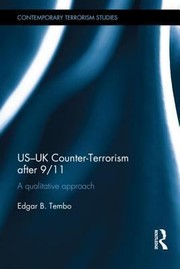
US-UK Counter-Terrorism After 9/11
by Edgar Tembo
No reviews yet
First published: 2014
1 language
ISBN: 9781136163463
Description
"This book provides a qualitative analysis of post 9/11 counter-terrorism strategy undertaken by the UK and USA.Since 9/11 both the UK and the USA have significantly revamped their counter-terrorism approaches. The approaches apply, to varying degrees three key policy instruments intelligence, law enforcement and military force. However the success or failure of these counter-terrorism strategies has never been satisfactorily validated. Analysts and policymakers alike have assumed success due to the inability of terrorists to conduct 7/7 and 9/11 respectively, scale attacks upon each state. This assumption has existed despite the fact that it fundamentally underestimates the impact of transnational terrorism.This volume provides an in-depth qualitative assessment of the three primary policy instruments implemented to counter the transnational threat of terrorism during the period 2001-2011 an approach somewhat neglected by the current body of literature which focuses on a purely quantitative methodology. Drawing upon previously unpublished data collected from interviews with policymakers, specialists and academics, US-UK Counter-Terrorism after 9/11 fills this lacuna by ascertaining and analysing both the UKs and USAs counter-terrorism strategies and developing a holistic approach to understanding these strategies.This book will be of interest to students of terrorism and counter-terrorism studies, security studies and IR in general. "--
"Utilising an innovative analytical framework, this book provides a qualitative analysis of the costs and benefits of the counter-terrorism policy of the UK and the USA. Since 9/11 both the USA and UK have significantly revamped their counter-terrorism approaches. The approaches apply, to varying degrees, three key policy instruments - intelligence, law enforcement and military force. However, the success or failure of these counter-terrorism strategies has never been satisfactorily validated. Analysts and policymakers alike have assumed their success due to the absence of the recurrence of a terrorist attack directly upon either state, despite the fact that such a quantitative assumption fundamentally underestimates the impact of transnational terrorism. This volume provides an in-depth qualitative assessment of the three primary policy instruments implemented to counter the transnational threat of terrorism during the period 2001-2009; an approach somewhat neglected by the current body of literature which focuses on a purely quantitative methodology. Drawing upon previously unpublished data collected from interviews with policymakers, specialists and academics, US-UK Counter-Terrorism after 9/11 fills this lacuna by ascertaining and analysing the costs and benefits of the UK's and USA's counter-terrorism strategies and developing a holistic approach to understanding these strategies. This book will be of interest to students of terrorism and counter-terrorism studies, security studies and IR in general"--
"Utilising an innovative analytical framework, this book provides a qualitative analysis of the costs and benefits of the counter-terrorism policy of the UK and the USA. Since 9/11 both the USA and UK have significantly revamped their counter-terrorism approaches. The approaches apply, to varying degrees, three key policy instruments - intelligence, law enforcement and military force. However, the success or failure of these counter-terrorism strategies has never been satisfactorily validated. Analysts and policymakers alike have assumed their success due to the absence of the recurrence of a terrorist attack directly upon either state, despite the fact that such a quantitative assumption fundamentally underestimates the impact of transnational terrorism. This volume provides an in-depth qualitative assessment of the three primary policy instruments implemented to counter the transnational threat of terrorism during the period 2001-2009; an approach somewhat neglected by the current body of literature which focuses on a purely quantitative methodology. Drawing upon previously unpublished data collected from interviews with policymakers, specialists and academics, US-UK Counter-Terrorism after 9/11 fills this lacuna by ascertaining and analysing the costs and benefits of the UK's and USA's counter-terrorism strategies and developing a holistic approach to understanding these strategies. This book will be of interest to students of terrorism and counter-terrorism studies, security studies and IR in general"--